



Febest Replacement Parts for Enthusiasts: 2026 Review
Table of Contents
- What Makes Febest Replacement Parts Worth Your Attention
- Febest Suspension and Steering Components Reviewed
- Driveline and Braking: CV Joints, Wheel Bearings, and Hub Assemblies
- Febest vs OEM Parts: Performance, Durability, and Value
- How to Check Suspension Wear Before You Order
- Febest Replacement Parts Fitment, Warranty, and DIY Support
- Conclusion
Last Updated: August 13, 2026
What Makes Febest Replacement Parts Worth Your Attention
Febest replacement parts have built a reputation beyond the average aftermarket brand. At Vertexark Auto Parts, we stock Febest components because they address a persistent frustration in DIY automotive maintenance: sourcing parts that actually fit, hold up, and perform without requiring a second purchase six months later.
Febest is a Japanese-origin aftermarket parts manufacturer specialising in chassis, suspension, and driveline components. The brand targets OEM-compatible specifications across Japanese, Korean, and European vehicles, making it particularly relevant for owners of popular models that have aged out of dealer support.
What separates Febest from lower-tier aftermarket brands is its engineering approach. Rather than simply replicating dimensions, Febest components match or improve on OEM material grades, particularly in rubber compounds for bushings and mounts. This matters enormously for vehicle handling and long-term mechanical reliability.
The brand’s catalogue covers suspension, steering, driveline, braking, and engine mount categories. For DIY enthusiasts working on older Japanese and domestic models, this breadth means a single supplier can often cover an entire undercarriage service. According to the ACCC’s guidance on product quality and consumer guarantees, consumers are entitled to expect parts that are fit for purpose and durable, which is precisely the standard Febest sets out to meet.
Febest Suspension and Steering Components Reviewed
Suspension and steering are where Febest genuinely earns its reputation. These components are most subject to wear, most likely to affect vehicle handling, and most frequently replaced by DIY enthusiasts.
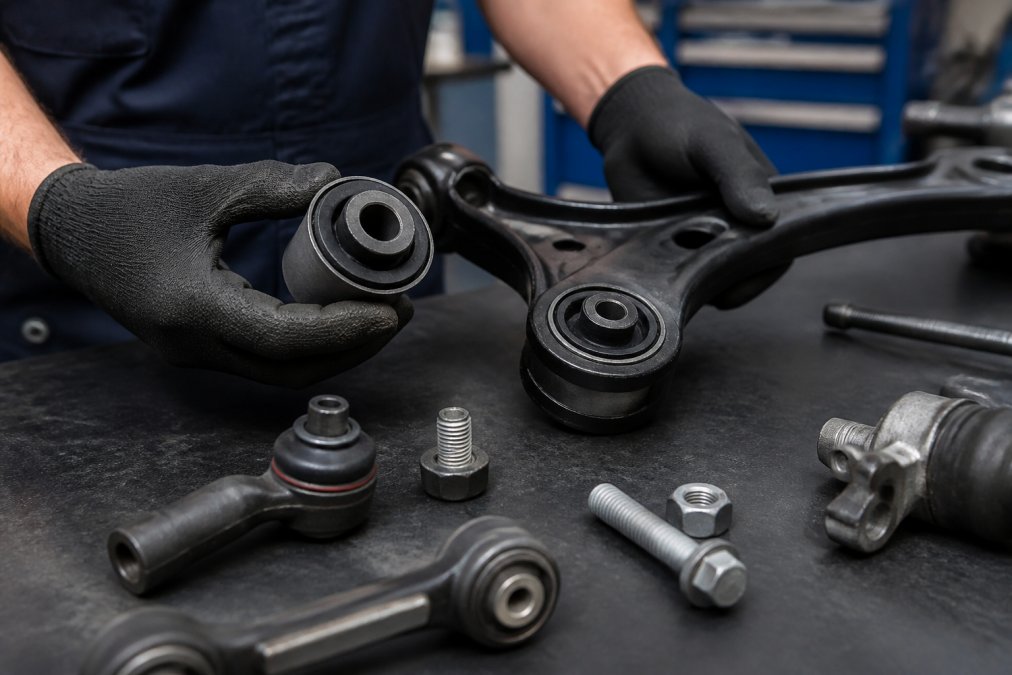
Control Arms, Ball Joints, and Tie Rod Ends
Control arms, ball joints, and tie rod ends are the three components most likely to fail together on a high-mileage vehicle, and Febest produces all three across an extensive range of makes and models.
Control arms from Febest are manufactured with forged steel bodies and pre-installed bushings. The bushing material is a notable point of difference: Febest uses a rubber compound that balances compliance with durability, the correct trade-off for a road car. Overly stiff polyurethane bushings transmit noise and vibration into the cabin and accelerate wear on adjacent components.
Ball joints are safety-critical. A failed ball joint can cause immediate loss of steering control. Febest ball joints are engineered to OEM torque and articulation specifications and include grease nipples on most applications, a detail many OEM-replacement brands omit. Greasing at service intervals extends service life significantly.
Tie rod ends from Febest cover inner and outer variants across most Japanese platforms. The precision engineering on thread pitch and taper fit is where cheaper alternatives often fall short, resulting in loose fitment and premature wear.
When replacing tie rod ends, always replace inner and outer as a pair. Replacing only one side shifts load to the worn end and accelerates its failure.
Stabiliser Links, Rubber Mounts, and Bushings
Stabiliser links, rubber mounts, and bushings represent the highest-volume replacement category in Febest’s suspension range and affect ride quality most directly.
Stabiliser links are often overlooked until they start knocking. Febest links use ball-and-socket ends with sealed boots, keeping grease in and moisture out. Many enthusiasts find the OEM stabiliser link on a 10-year-old vehicle has cracked boots and dry joints long before the link itself fails.
Rubber mounts and bushings showcase Febest’s engineering strength. The rubber compound is formulated to resist oil contamination, ozone cracking, and heat cycles that destroy lower-grade materials. On older Japanese platforms where OEM bushings are no longer available from dealers, Febest is often the only quality option. The bushing fitment precision ensures components do not move in their housings under load, which would create noise and accelerate wear.
Driveline and Braking: CV Joints, Wheel Bearings, and Hub Assemblies
Driveline components are where poor part quality becomes immediately obvious. A failing CV joint or wheel bearing does not gradually degrade; it fails in a way that can leave a vehicle undriveable or unsafe.
CV joints from Febest are available as complete boot kits, inner joints, and outer joints. The grease quantity and specification included in Febest CV kits is matched to the joint design, which matters significantly. Using the wrong grease quantity accelerates wear dramatically.
Wheel bearings in the Febest range cover both pressed-in and hub-assembly formats. Hub assemblies are more convenient for DIY installers because they eliminate the need for a bearing press. Febest hub assemblies are pre-set and pre-greased, requiring no adjustment after installation.
Hub assemblies also integrate the ABS tone ring on applicable vehicles. Febest’s attention to this detail means the ABS system functions correctly after installation without additional calibration, a common failure point with lower-quality alternatives.
For braking system components, Febest produces brake caliper repair kits, including pistons, seals, and dust boots. These are particularly useful for restoring seized calipers on older vehicles where new replacement calipers are expensive or unavailable.
Never replace only one wheel bearing on an axle if both show signs of wear. Uneven bearing preload affects handling and places asymmetric load on the new bearing. Replace as a pair when mileage or wear indicates both are near end of life.
Febest vs OEM Parts: Performance, Durability, and Value
The Febest vs OEM parts question is common in DIY automotive circles, and the honest answer is more nuanced than either camp usually admits.
Where Febest Matches OEM Standards
For the majority of chassis and suspension components, Febest matches OEM standards in the ways that matter most for everyday driving. Dimensional accuracy, material specification, and fitment precision are consistent with original equipment on Japanese and Korean platforms where Febest has the deepest catalogue coverage.
The rubber compound quality in Febest bushings and mounts is frequently cited by workshop technicians as equal to or better than OEM on vehicles more than eight years old. This is partly because OEM suppliers sometimes reduce material specification on replacement parts compared to original production parts.
According to Standards Australia’s guidance on automotive aftermarket components, aftermarket parts that meet equivalent dimensional and material standards to OEM are considered fit for purpose under Australian Consumer Law. Febest’s engineering documentation supports this claim across most of its product range.
Where OEM Still Has the Edge
OEM holds an advantage in two specific areas: proprietary calibration and brand-new vehicles.
For components requiring software calibration after installation, such as steering angle sensors or electronic suspension modules, OEM parts include calibration data that aftermarket alternatives cannot replicate. Febest does not produce electronic components.
On vehicles still within their original service life, OEM parts maintain warranty alignment with the manufacturer. Once a vehicle is out of warranty, the value calculation shifts decisively toward quality aftermarket options like Febest.
| Category | Febest | OEM |
|---|---|---|
| Rubber bushings and mounts | Matches or exceeds OEM on older vehicles | Superior on new vehicles |
| Ball joints and tie rod ends | OEM-equivalent fitment and articulation | Marginally better on some premium platforms |
| CV joints and boots | Correct grease specification included | Grease spec may differ by application |
| Hub assemblies | Pre-set, ABS tone ring included | Pre-set, full OEM integration |
| Electronic components | Not produced | Only OEM option |
| Price point | More accessible | Higher, especially for dealer supply |
| Availability (older vehicles) | Often better than OEM | Limited or discontinued |
How to Check Suspension Wear Before You Order
Ordering the right parts starts with accurate diagnosis. Many enthusiasts over-order because they cannot distinguish wear from failure, and under-order because they miss a secondary component that fails shortly after the primary repair.
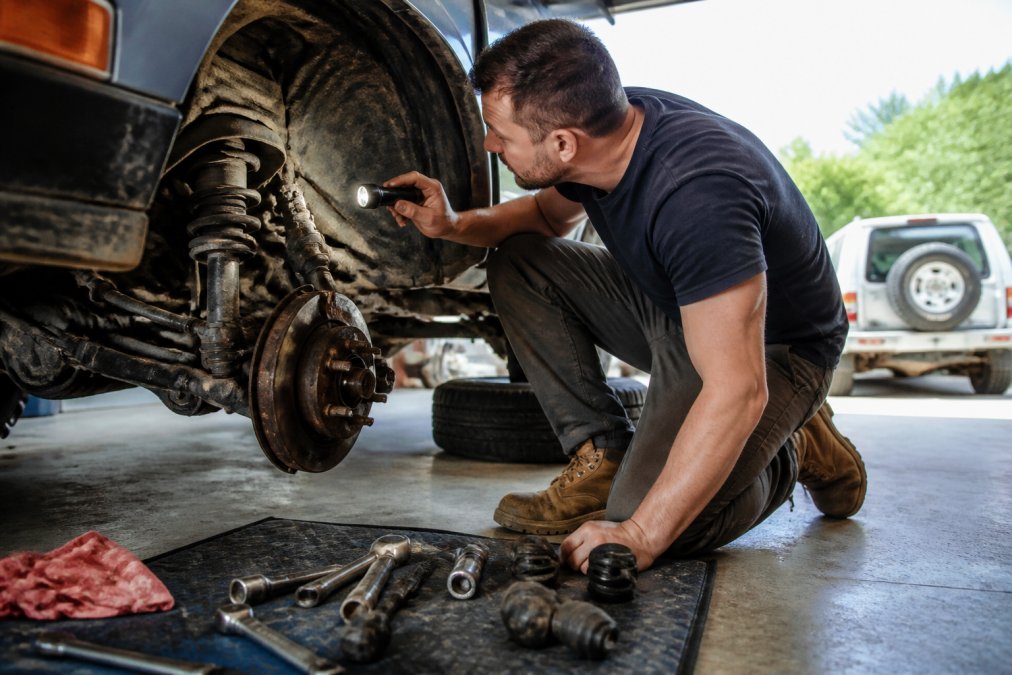
Visual and Physical Inspection Steps
Checking suspension wear accurately requires the vehicle to be safely raised and supported on stands. Never inspect under-body parts with only a jack supporting the vehicle.
Step 1: Inspect rubber components visually. Check all visible bushings, stabiliser link boots, and CV boots for cracking, tearing, or grease contamination. A cracked boot will fail soon without intervention.
Step 2: Check for play in ball joints and tie rod ends. With the wheel off the ground, grip the tyre at the 12 and 6 o’clock positions and attempt to rock it. Any movement indicates a worn ball joint. Repeat at the 3 and 9 o’clock positions to check tie rod ends.
Step 3: Inspect wheel bearings under load simulation. With the wheel on the ground, grip the tyre at 12 and 6 and rock firmly. A worn wheel bearing produces movement or a grinding sensation. Spin the wheel by hand with it off the ground; rough or notchy rotation confirms bearing wear.
Step 4: Check stabiliser links for looseness. Grip each stabiliser link and attempt to move it laterally. A worn link will have noticeable play at the ball ends.
Step 5: Look for oil or grease contamination. Engine oil or power steering fluid contaminating rubber bushings accelerates their degradation. Address the source of any leak before replacing the bushings, or the new parts will fail prematurely.
Installation Difficulty Ratings by Component Type
Understanding installation difficulty before you order helps you plan correctly and avoid surprises.
| Component | Difficulty | Special Tools Required | Notes |
|---|---|---|---|
| Stabiliser links | Easy | Basic spanners | 15-30 minutes per side |
| Tie rod ends | Easy-Medium | Tie rod puller, alignment after | Alignment required post-installation |
| CV boots (in situ) | Medium | CV boot clamp pliers | Joint must be cleaned thoroughly |
| Ball joints | Medium-Hard | Ball joint press or separator | Torque settings critical |
| Control arms | Medium-Hard | Torque wrench, alignment after | Alignment required post-installation |
| Wheel bearings (pressed) | Hard | Hydraulic press | Not recommended for home workshop |
| Hub assemblies | Medium | Torque wrench | Press-free, suitable for DIY |
According to the Australian Automotive Aftermarket Association’s technical resources, correct torque application on suspension fasteners is one of the most common sources of premature component failure in DIY installations. Always torque to specification with the suspension at ride height, not with the wheel hanging.
Hub assemblies are the DIY-friendly alternative to pressed wheel bearings. If your vehicle application supports a Febest hub assembly, choose it over a loose bearing, particularly if you do not have access to a press.
Febest Replacement Parts Fitment, Warranty, and DIY Support
The practical side of ordering Febest replacement parts matters as much as technical quality. Fitment accuracy, warranty coverage, and access to support determine whether a parts purchase is straightforward or frustrating.
Fitment is the first concern for most DIY buyers. Febest’s catalogue is structured around precise vehicle fitment data, cross-referenced by make, model, year, and engine code. This level of detail reduces fitment errors significantly compared to suppliers using generic application data.
Vertexark Auto Parts lists Febest components with guaranteed exact fit, verified against the vehicle specification before dispatch. If a fitment issue arises, the returns process is straightforward with a clear policy.
Warranty coverage on Febest parts through Vertexark Auto Parts is backed by an industry-leading warranty, particularly relevant for safety-critical components like ball joints and wheel bearings. The warranty applies to manufacturing defects rather than installation errors, aligning with consumer guarantees provisions under Australian Consumer Law.
For enthusiasts uncertain which specific part number applies to their vehicle, expert support is available. This is not an automated lookup only: real assistance when a vehicle has been modified, has non-standard engine fitment, or sits between model year specifications prevents costly ordering mistakes.
Fast shipping means most orders reach buyers within a practical timeframe for weekend workshop projects. The Febest range available through Vertexark Auto Parts covers the most common Japanese and domestic platforms, with fitment data updated to reflect current production runs. For older vehicles where OEM parts are discontinued, this availability is often the deciding factor.
Frequently Asked Questions
Are Febest parts OEM quality?
Febest parts are manufactured to OEM-compatible specifications, meaning they are engineered to match the original component's dimensions, material grades, and performance tolerances. For most daily-driven and enthusiast vehicles, particularly Japanese makes, they perform comparably to genuine OEM parts in real-world conditions. The key difference is cost: Febest replacement parts typically sit below dealership pricing without sacrificing the precision engineering needed for reliable automotive repair and chassis component replacement.
Are Febest engine mounts good for performance or modified vehicles?
Febest engine mounts are well-suited to standard and mildly modified vehicles. They use high-grade rubber compounds that absorb vibration effectively under normal and moderate load conditions. For heavily modified or track-focused builds generating significantly higher torque, a stiffer aftermarket or polyurethane mount may be more appropriate. For the majority of DIY enthusiasts maintaining or restoring a road-going vehicle, Febest mounts offer reliable mechanical reliability and a straightforward installation process.
How do I know Febest replacement parts will fit my specific vehicle?
Febest publishes a detailed parts catalogue organised by vehicle make, model, year, and chassis code. Before ordering, cross-reference your vehicle's chassis number or engine code against the Febest fitment data. Retailers like Vertexark Auto Parts offer a guaranteed exact fit and expert support to confirm compatibility, which removes the guesswork that causes wrong-fitment orders. If you are unsure, contact support with your vehicle details before purchasing.
How do I check whether my suspension components need replacing?
Start with a visual inspection of bushings, control arms, and stabiliser links for cracking, tearing, or deformation in the rubber. Then grip each wheel at 9 and 3 o'clock and attempt to rock it, excessive play points to worn wheel bearings or ball joints. Check tie rod ends by gripping the rod and feeling for looseness. A road test that reveals pulling, vibration through the steering wheel, or clunking over bumps confirms wear and tear that warrants replacement.
Where can I access the Febest catalogue for specific vehicle fitments?
The official Febest catalogue is available through authorised distributors and stocked retailers. Vertexark Auto Parts carries a broad range of Febest replacement parts with vehicle-specific fitment data accessible on their website. You can search by make, model, and year to confirm which part number suits your application. For older Japanese models or less common domestic vehicles, the catalogue detail is particularly thorough, covering suspension, driveline, steering, and engine mount categories.
Sourcing quality chassis and suspension components for a DIY repair means balancing fitment accuracy, material quality, and supplier reliability. Febest replacement parts address all three, and Vertexark Auto Parts stocks the full range with guaranteed exact fit, an industry-leading warranty, and fast shipping to get your vehicle back on the road. Shop Now at Vertexark Auto Parts and find the right Febest component for your make and model.
This article was written using GrandRanker