



Fast Shipping for Critical Car Parts: 2026 Guide
Table of Contents
- Why Fast Shipping for Critical Car Parts Matters
- Courier vs. Air Freight vs. Road Express: Which to Choose
- Same Day Auto Parts Delivery: What’s Actually Possible
- Handling Oversized and Heavy Automotive Components
- Customs Clearance for Car Parts: Avoiding Costly Delays
- Risk Mitigation for High-Value Critical Components
- Inventory Management and Just-in-Time Workshop Repairs
- How to Get Fast Shipping for Critical Car Parts Right
Last Updated: August 14, 2026
Why Fast Shipping for Critical Car Parts Matters
Fast shipping for critical car parts is the difference between a vehicle back on the road within hours and a workshop grinding to a halt for days. Every hour a car sits idle has a real cost: missed work, cancelled appointments, and mounting frustration. For DIY mechanics and professional workshops alike, the supply chain behind automotive components is not a background concern, it is the repair timeline itself.
At Vertexark Auto Parts, customers ordering brake callipers, timing chains, or engine sensors need the part correct and fast. The logistics chain that delivers it is therefore just as important as the part itself. According to Austroads research on vehicle supply chains, parts availability and transit time are among the top friction points for vehicle owners managing their own repairs.
Understanding how different freight options work gives you genuine control over your repair timeline.
Courier vs. Air Freight vs. Road Express: Which to Choose
The right freight mode for fast shipping of critical car parts depends on three factors: urgency, part size, and origin point. Each mode has a distinct performance profile.

| Freight Mode | Best For | Typical Transit Time | Key Limitation |
|---|---|---|---|
| Road Express | Metro-to-metro, parts under 30 kg | 1-3 business days | Slower for remote areas |
| Air Freight | Urgent interstate or international parts | Same day to 2 days | Higher cost, size restrictions |
| Courier (parcel) | Small components, standard delivery | 2-5 business days | Not suited to oversized parts |
When Road Express Is the Right Call
Road express is the workhorse of domestic automotive freight. For parts under 30 kg moving between major centres, it delivers the best balance of speed and cost. Most express road networks operate overnight services between capital cities, meaning a part ordered before the afternoon cut-off arrives the following morning.
The limitation is geography. Remote and regional destinations add one to three days to estimates. Road express also suits freight consolidation, where multiple parts are grouped into a single consignment, reducing per-unit cost without sacrificing speed.
When Air Freight Beats Everything Else
Air freight is the right call when time is the only variable that matters. For urgent interstate dispatch or time-critical delivery from overseas suppliers, air freight compresses a three-day road transit into same-day or next-morning delivery.
The trade-off is cost. Air freight rates are meaningfully higher than road express, and for heavy components the gap widens further. It is worth the premium when workshop downtime costs more than the freight surcharge. Air freight also integrates cleanly with international supply chains, with parts clearing customs at a major airport moving directly onto domestic air service.
Same Day Auto Parts Delivery: What’s Actually Possible
Same day auto parts delivery is possible but requires the right combination of stock location, freight network, and order timing. For same-day delivery to be viable, three conditions must be met: the part must be in a local or regional warehouse, the order must be placed before the carrier’s cut-off time (typically mid-morning), and the delivery address must fall within the carrier’s same-day zone. Metropolitan areas are well-served; regional and rural addresses rarely qualify.
Where same-day delivery is not available, express next-morning services through major road freight networks are the practical alternative. For most urgent repair scenarios, a part ordered by early afternoon arriving before 9 am the following day meets the functional requirement.
The parts most commonly needed same-day are high-failure consumables: brake pads, filters, belts, sensors, and lighting components. Stocking these locally is the most reliable way to achieve genuine same-day availability.
If you need a part urgently, call your supplier before placing an online order. A phone confirmation of stock location and cut-off time can save hours compared to placing an order and waiting for a dispatch notification.
Handling Oversized and Heavy Automotive Components
Oversized and heavy automotive components, engine blocks, gearboxes, suspension assemblies, exhaust systems, sit outside the standard parcel network entirely. They require heavy haulage services, specialist packaging, and logistics coordination that standard courier bookings cannot accommodate.
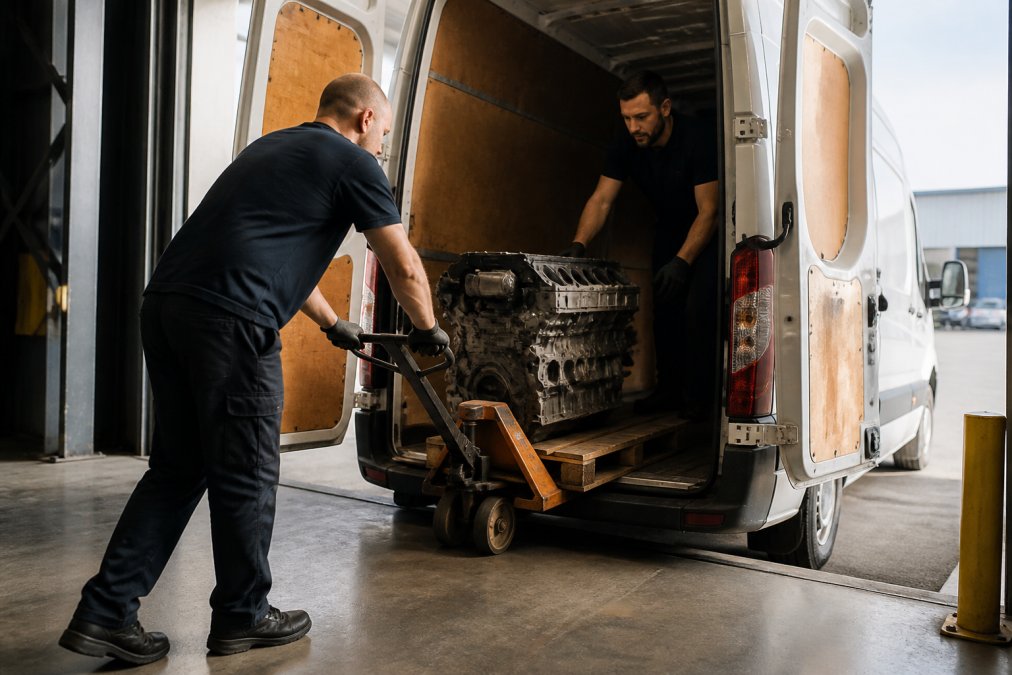
The first challenge is packaging standards. An engine block or differential assembly needs to be palletised, secured against movement, and protected from impact across multi-leg transit. Inadequate packaging is the most common cause of freight damage claims on heavy automotive components.
Key considerations for oversized automotive freight:
- Pallet or crate requirement: Most carriers require items over 25 kg to be palletised. Confirm this before booking.
- Tail-lift access: Delivery addresses without loading dock access need a tail-lift vehicle. Book this explicitly.
- Freight insurance: For high-value components, declared value insurance is non-negotiable. Standard carrier liability limits are low relative to replacement costs.
- Shipping surcharges: Oversized items attract dimensional weight surcharges. Get freight quotes reflecting actual packed dimensions.
Transit times for heavy haulage are longer than express parcel services. A realistic expectation for interstate heavy freight is two to four business days, with remote destinations taking longer.
Never book an oversized automotive component through a standard parcel service. Always use a carrier that explicitly handles heavy haulage and confirm their maximum weight and dimension limits before booking.
Customs Clearance for Car Parts: Avoiding Costly Delays
Customs clearance for car parts is one of the most underestimated sources of delay in international automotive supply chains. A part that ships from Japan or the United States in two days can sit in a customs queue for a week if documentation is incomplete or classification is incorrect.
Automotive components span many tariff classifications under the Australian Border Force customs tariff schedule, and misclassification is common. An engine sensor classified as a generic electronic component rather than an automotive part may be held for additional assessment.
Import Duties and GST on Automotive Parts
GST applies to all imported goods entering Australia, including automotive parts. Import duties on automotive components vary by type and country of origin. Parts sourced from countries with which Australia has a free trade agreement may attract reduced or zero duty rates. The Australian Border Force guide to importing goods provides the current tariff schedule.
To minimise customs delays:
- Ensure the commercial invoice includes the correct HS (Harmonised System) tariff code for each part.
- Confirm the declared value accurately reflects the transaction value.
- Use a licensed customs broker for high-value or complex shipments.
- Confirm whether your supplier has lodged an import declaration.
Air freight shipments clear customs faster than sea freight, because air cargo terminals are processed more frequently.
Risk Mitigation for High-Value Critical Components
The biggest mistake in automotive parts logistics is treating a high-value component the same as a low-value consumable. A timing kit or fuel injection assembly represents significant cost; losing it to freight damage without adequate cover is avoidable.
Risk mitigation starts before the part leaves the supplier. Confirm that:
- The part is correctly identified and matched to your vehicle specification before dispatch.
- Freight insurance is declared at replacement value, not purchase price.
- Shipment tracking is active and you have the consignment number before the part leaves the warehouse.
For high-value international shipments, consider the risk profile of the shipping route. A logistics provider with experience in automotive freight will know which routes carry higher risk.
Freight insurance on high-value automotive components is not optional, it is part of the true cost of the part. Calculate it into your total landed cost from the start.
According to the Australian Competition and Consumer Commission’s guidance on online purchases, consumers have rights when goods arrive damaged or do not match their description.
Inventory Management and Just-in-Time Workshop Repairs
Just-in-time inventory management for workshop repairs is the practice of ordering parts only when needed, relying on fast shipping rather than holding large stock on hand. It reduces carrying costs and frees up workshop space, but it transfers risk onto the supply chain.
The model works when the supply chain is reliable. The practical approach is a hybrid: hold fast-moving consumables in stock, and rely on express shipping for lower-frequency components.
| Part Category | Recommended Approach | Reorder Trigger |
|---|---|---|
| High-frequency consumables (filters, pads, belts) | Hold minimum stock | When stock falls below 2-week supply |
| Mid-frequency components (sensors, hoses, gaskets) | Order on demand, express shipping | At point of repair booking |
| Low-frequency / high-value (engine, gearbox parts) | Order on confirmed job | On confirmed vehicle booking |
| Oversized / heavy components | Order with lead time buffer | 5+ days before scheduled repair |
Supplier reliability matters as much as freight speed. A supplier with consistent dispatch times and accurate stock data allows tighter just-in-time scheduling. Inventory replenishment cycles should be reviewed quarterly, with parts that consistently cause delays considered for local stocking.
How to Get Fast Shipping for Critical Car Parts Right
Getting fast shipping for critical car parts right is a systems problem, not a one-time decision. Here is a practical checklist:
- Confirm stock availability before placing the order
- Check the supplier’s daily dispatch cut-off time and order before it
- Select the freight mode based on urgency, part size, and destination
- Obtain a consignment number and activate tracking before the part leaves the warehouse
- Declare freight insurance on any component valued above your acceptable loss threshold
- For international orders, confirm HS tariff codes and GST obligations before dispatch
- Build one to two days of buffer into repair scheduling for interstate freight
- For oversized components, confirm tail-lift access and pallet requirements at booking
The most common failure point is the handover gap between a supplier confirming dispatch and the freight carrier actually collecting the consignment. This gap can add half a day or more to effective transit time. Ask your supplier explicitly whether same-day collection is guaranteed.
Fast shipping for critical car parts ultimately depends on choosing a supplier with genuine logistics infrastructure. Vertexark Auto Parts backs its fast shipping commitment with an industry-leading warranty and a guaranteed exact fit policy, so the part that arrives quickly is also the part that fits and works. The freight options, customs requirements, and inventory strategies covered here give you the tools to make informed decisions at every stage of the supply chain.
Frequently Asked Questions
How fast is car parts shipping within Australia?
Transit times vary by service type and distance. Metro-to-metro express road freight typically delivers within 1-2 business days. Air freight between major hubs can arrive overnight or same day for urgent orders placed before cut-off times. Regional and remote destinations take longer, often 3-5 business days. The fastest shipping for critical car parts combines early order cut-offs, express dispatch, and real-time shipment tracking to minimise workshop downtime.
Are there import duties on car parts ordered from overseas?
Most automotive components imported into Australia attract a 5% customs duty rate under the Australian Border Force's tariff schedule, plus 10% GST on the customs value plus freight and insurance. Some parts, particularly those covered by free trade agreements with Japan, South Korea, or Thailand, may attract reduced or zero duty rates. A licensed customs broker can confirm the correct tariff classification and duty rate for your specific part before you order, avoiding surprise charges on arrival.
What are the fastest shipping options for heavy automotive components?
Heavy parts such as engines, gearboxes, and differentials are generally too large for standard courier networks. Road express freight with a dedicated heavy haulage carrier is the most practical option for same-day or next-day delivery within metro areas. For time-critical interstate moves, air freight on commercial cargo flights handles oversized cargo up to certain weight limits. Always confirm dimensional and weight restrictions with your freight provider before booking, as shipping surcharges apply to non-standard loads.
How can I track an urgent automotive freight shipment?
Reputable freight providers issue a consignment number at dispatch that links to a live tracking portal. Most express carriers update scan events at each depot handover, giving visibility from pick-up through to last-mile delivery. For critical car parts, request email or SMS notifications at key milestones. If your supplier uses a 3PL storage and fulfilment partner, ask for the carrier's tracking reference directly rather than relying solely on the supplier's order status page, which may lag behind real-time scan data.
Workshop downtime and delivery uncertainty are the two costs that fast shipping for critical car parts is designed to eliminate. Vertexark Auto Parts addresses both with fast dispatch, guaranteed exact fit across a comprehensive range of engine components, lighting, and accessories, and an easy returns process backed by industry-leading warranty coverage. Shop now at Vertexark Auto Parts and get your vehicle back on the road without the wait.
This article was written using GrandRanker