



DIY Car Maintenance for Beginners: 2026 Guide
Table of Contents
- Why DIY Car Maintenance Makes Financial Sense
- Essential Car Maintenance Tools for Beginners
- Your DIY Car Service Checklist: Fluids, Filters and More
- Tyres, Battery and Belts: DIY Car Maintenance Checks That Matter
- Troubleshooting Common Warning Light False Alarms
- Disposing of Hazardous Waste the Right Way
- When to See a Professional Mechanic
- Conclusion
Last Updated: August 11, 2026
Why DIY Car Maintenance Makes Financial Sense
DIY car maintenance, performing routine checks, fluid top-ups, filter replacements, and minor repairs yourself, is one of the most effective ways to reduce ongoing vehicle costs without compromising reliability. Professional labour rates have climbed steadily, yet many routine tasks like checking engine oil, replacing a cabin air filter, or inspecting tyre pressure require no specialist equipment and take under 30 minutes. The real financial argument is catching small problems before they become expensive ones.
At Vertexark Auto Parts, we serve car owners by offering a vast inventory of components, ranging from engine parts and lighting to interior and exterior accessories, all backed by our commitment to an exact fit. You also know exactly what went into your car, no substituted fluids, no skipped steps, no uncertainty about whether the job was actually done.
Routine DIY maintenance is not just about saving money. It is about staying informed about your vehicle’s condition before a minor issue becomes a repair bill.
Essential Car Maintenance Tools for Beginners
The biggest mistake beginners make is buying tools reactively, ending up with a mismatched collection that never quite covers the next task. A better approach is to build a core kit upfront that handles 80% of what you will ever need.
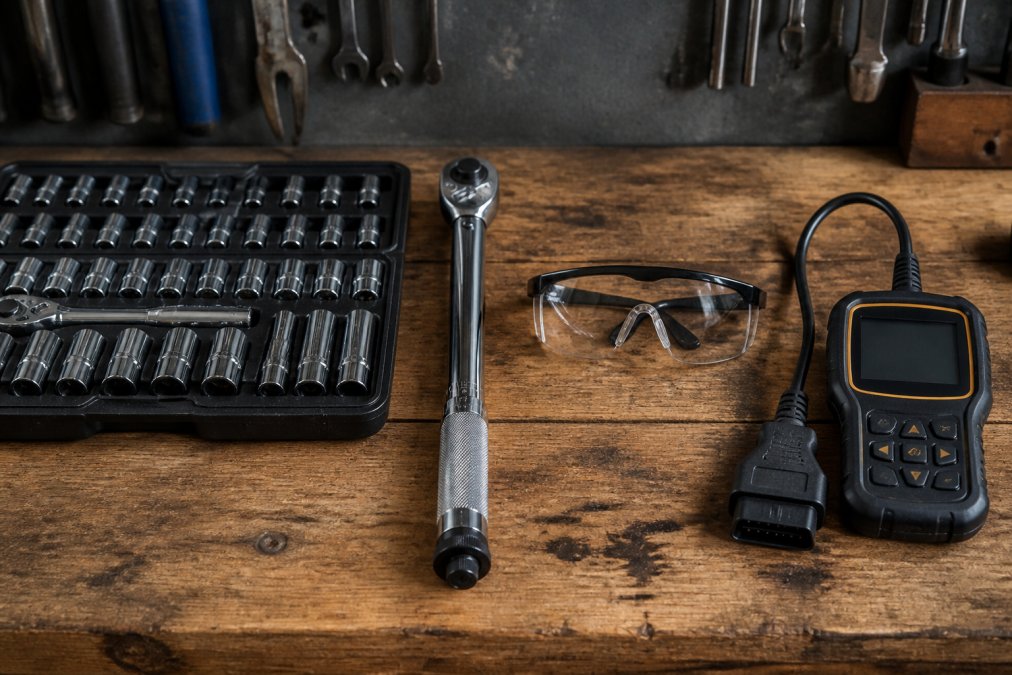
Basic Hand Tools Every Beginner Needs
A solid starter kit does not need to be expensive. Focus on quality for the tools you will use most often.
| Tool | Primary Use | Why It Matters |
|---|---|---|
| Socket set (metric) | Removing bolts and fasteners | Covers most under-bonnet tasks |
| Torque wrench | Wheel nuts, drain plugs | Prevents over-tightening damage |
| Combination spanner set | Hose clamps, battery terminals | Faster than sockets in tight spaces |
| Screwdriver set (flat + Phillips) | Panels, filter housings | Used on almost every job |
| Safety goggles | Eye protection | Non-negotiable near fluids |
| Funnel and drain pan | Oil and fluid changes | Keeps spills contained |
| Jack stands | Working under the vehicle | Never use a trolley jack alone |
A quality jack stand set is worth the investment. Working under a vehicle supported only by a trolley jack is genuinely dangerous. According to Safe Work Australia’s guidance on vehicle maintenance hazards, unsupported vehicles are a leading cause of crush injuries in home garage settings.
Digital Diagnostic Tools: OBD-II Scanners Explained
An OBD-II scanner plugs into your vehicle’s diagnostic port and reads fault codes stored by the engine control unit. Every petrol and diesel passenger vehicle sold in Australia since 2006 supports the OBD-II protocol, meaning this tool works across virtually every modern car. Warning lights are the single most anxiety-inducing part of car ownership; an OBD-II scanner converts a cryptic dashboard symbol into a specific diagnostic trouble code, which you can then look up to understand whether the issue is urgent or minor. Entry-level Bluetooth scanners pair with a smartphone app and cost a fraction of a workshop diagnostic fee.
Tool Maintenance and Storage Tips
Tools last decades if stored correctly. Wipe metal tools dry after use to prevent surface rust, store them in a sealed chest rather than an open shelf, and apply a light coat of machine oil to chrome-vanadium tools once or twice a year. Keep your torque wrench wound back to its lowest setting when not in use; leaving it under tension weakens the calibration spring. A well-maintained tool kit is also a safety kit, worn sockets slip under load and round off bolt heads.
Your DIY Car Service Checklist: Fluids, Filters and More
The most practical DIY car service checklist covers fluids, filters, and components that degrade on a predictable schedule. Work through these checks every three months or every 5,000 kilometres, whichever comes first, and you will catch the vast majority of issues before they develop into failures.
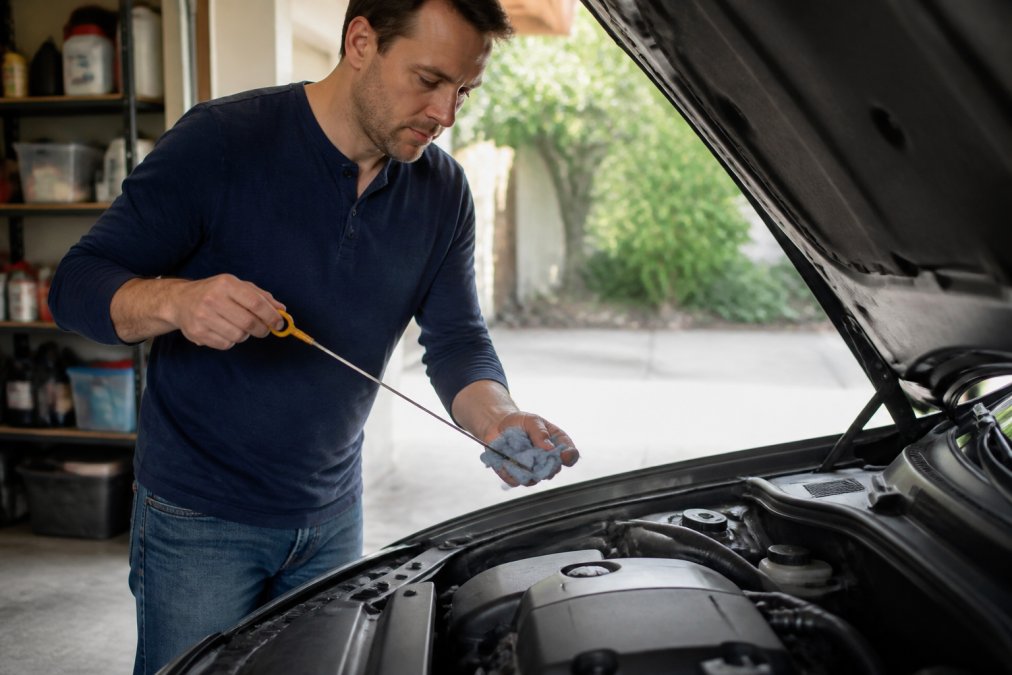
Engine Oil: Checking Levels and Topping Up
Checking engine oil is the single most important routine check you can do. Low oil pressure causes rapid engine wear, and by the time a warning light appears, damage may already be occurring.
How to check engine oil correctly:
- Park on level ground and let the engine cool for at least 10 minutes after driving
- Locate the dipstick (usually a brightly coloured handle near the engine block)
- Pull the dipstick out, wipe it clean with a lint-free cloth, and reinsert it fully
- Pull it out again and read the oil level against the MIN and MAX markings
- If the level is below the midpoint, add the correct viscosity oil in small amounts and recheck
Your vehicle identification number (VIN) and owner’s manual will specify the correct viscosity grade, such as 5W-30 or 10W-40. Synthetic oil generally offers better protection across a wider temperature range than conventional mineral oil, but check your service manual before switching.
Never overfill engine oil above the MAX mark on the dipstick. Excess oil can foam under pressure, reducing its ability to lubricate and potentially damaging seals.
Coolant, Brake Fluid and Windscreen Washer Fluid
Coolant (radiator fluid): Check the overflow reservoir when the engine is cold. The level should sit between the MIN and MAX lines. Never open a hot radiator cap. Coolant degrades over time and loses its corrosion-inhibiting properties, so a full flush every two years is standard practice.
Brake fluid: Locate the brake fluid reservoir on the driver’s side of the firewall. The level drops gradually as brake pads wear. If the fluid appears dark or murky, it has absorbed moisture and should be replaced. According to the RACQ’s vehicle maintenance guidance, brake fluid should be replaced every two years as a general rule.
Windscreen washer fluid: Use a purpose-made washer fluid concentrate rather than plain water. Plain water does not clean effectively and can freeze in cold overnight temperatures.
Cabin Air Filter and Engine Air Filter Replacement
Cabin air filter: Located behind the glovebox or under the dashboard on most vehicles, this filter cleans the air entering the passenger cabin. A clogged cabin air filter reduces airflow noticeably and can harbour mould. Replacement takes around 15 minutes with no tools required on most Japanese models.
Engine air filter: Housed in the airbox connected to the intake manifold, a dirty engine air filter restricts airflow to the engine, reducing fuel efficiency and throttle response. Most vehicles need a new one every 15,000 to 20,000 kilometres, but dusty driving conditions shorten that interval considerably.
Tyres, Battery and Belts: DIY Car Maintenance Checks That Matter
These three areas cause the most unexpected breakdowns. A flat tyre, a dead battery, or a snapped drive belt are all events that DIY car maintenance checks can prevent with minimal effort.
Tyre Pressure and Tread Depth
Correct tyre pressure affects fuel consumption, handling, tyre life, and braking distance. The recommended pressures for your vehicle are printed on a sticker inside the driver’s door jamb or in the owner’s manual, and they differ between front and rear axles on many vehicles. Check pressure when the tyres are cold (driven less than 3 kilometres).
Tread depth: The legal minimum tread depth across all tyre grooves in Australia is 1.5 millimetres, as specified under the Australian Road Rules and vehicle standards administered by the National Heavy Vehicle Regulator. A practical way to check is the 20-cent coin test: insert a 20-cent coin into the tread groove. If the platypus’s bill is fully visible, the tread is approaching the legal limit and replacement should be planned. Tyre rotation every 10,000 kilometres extends tyre life by evening out wear patterns.
Battery Terminals, Health and Jump Starting
Battery terminals corrode over time, increasing electrical resistance and causing slow cranking, false electrical faults, and eventually a no-start condition. Cleaning terminals is a five-minute job with a wire brush and a mixture of bicarbonate of soda and water. A healthy battery should hold a charge above 12.6 volts at rest. If the battery is more than four years old and showing slow cranking, replace it proactively.
Jump starting safely:
- Position the working vehicle so the batteries are close without the vehicles touching
- Connect red (positive) clamp to the flat battery’s positive terminal
- Connect the other red clamp to the good battery’s positive terminal
- Connect black (negative) clamp to the good battery’s negative terminal
- Connect the final black clamp to an unpainted metal surface on the flat vehicle (not the battery terminal)
- Start the working vehicle, wait two minutes, then attempt to start the flat vehicle
After a successful jump start, drive for at least 30 minutes to allow the alternator to recharge the battery. Switching the engine off immediately after a jump start often results in another flat battery within hours.
Drive Belts, Hoses and Windscreen Wiper Blades
Drive belts and hoses degrade from heat cycling and age. A visual inspection every service interval takes minutes and can prevent a roadside breakdown. Look for fraying, cracking along the ribs, glazing, or missing chunks on belts. Squeeze coolant and radiator hoses when cold, they should feel firm but not brittle. Soft, mushy spots indicate internal breakdown. Windscreen wiper blades showing streaking, skipping, or chattering need replacement at least once a year, or before winter if your area experiences heavy rain.
Troubleshooting Common Warning Light False Alarms
Warning lights are not always what they appear to be. Understanding the difference between a genuine fault and a false alarm saves unnecessary workshop visits.
The check engine light covers hundreds of possible fault codes, ranging from a loose fuel cap to a misfiring cylinder. Before assuming the worst, check that the fuel cap is fully tightened. An OBD-II scanner will retrieve the specific diagnostic trouble code and tell you whether the fault is active or stored.
The tyre pressure warning light (TPMS) sometimes triggers after a temperature drop overnight, because cold air contracts and reduces tyre pressure. Check pressures with a gauge before assuming a puncture.
The battery light during normal driving can indicate a failing alternator rather than a battery problem. If the light appears while driving, reduce electrical load and head to a workshop promptly.
Oil pressure warning: This one is not a false alarm. If the oil pressure light illuminates while driving, stop the engine as soon as it is safe to do so. Continuing to drive with low oil pressure causes rapid and severe engine damage.
Disposing of Hazardous Waste the Right Way
Used engine oil, old coolant, brake fluid, and worn batteries are classified as hazardous waste under state environmental protection legislation. Pouring them down a drain, onto the ground, or into general rubbish is illegal and causes serious environmental harm.
- Used engine oil and oil filters: Most service stations and auto parts retailers accept used oil for recycling through the Australian Used Oil Recovery Program administered by the Department of Climate Change, Energy, the Environment and Water. This is free of charge at participating sites.
- Old coolant: Collect it in a sealed container and take it to your local council’s household hazardous waste drop-off facility.
- Brake fluid: Dispose of through council collection programs.
- Old batteries: Most auto parts retailers accept them for recycling at no charge.
Never mix used fluids in a single container.
When to See a Professional Mechanic
Knowing the limits of DIY car maintenance is as important as knowing what you can do yourself. See a professional mechanic when the brake pedal feels soft or spongy, you notice unidentified fluid leaks, the steering pulls consistently to one side, diagnostic trouble codes point to transmission, ABS, or airbag system faults, any work involves the fuel system, high-voltage hybrid components, or air conditioning refrigerant, or the vehicle fails a roadworthy inspection for structural or safety-critical items. A professional inspection is also worth scheduling after any collision, even a minor one.
The goal of DIY car maintenance is not to replace your mechanic entirely. It is to arrive at a workshop informed, with a well-maintained vehicle, needing only the work that genuinely requires specialist skills.
Keeping up with routine vehicle maintenance is straightforward once you have the right knowledge and parts. Vertexark Auto Parts offers a comprehensive range of replacement components, from oil filters and air filters to belts, hoses, and wiper blades, all backed by a guaranteed exact fit and industry-leading warranty. Whether you are topping up fluids or tackling your first filter swap, shop now at Vertexark Auto Parts and get the right part for your specific vehicle, with fast shipping and real support if you need it.
Frequently Asked Questions
Can I perform my own car service without voiding my warranty?
Yes, in most cases. Under Australian Consumer Law, a manufacturer cannot void your new car warranty simply because you chose to have servicing done outside a dealership, provided the work meets the manufacturer's specifications and is recorded properly. Keep receipts for all parts and fluids used, and log every service in your vehicle's logbook. Using quality parts that match the manufacturer's specifications is essential to protecting your coverage.
What essential tools do I need to start DIY car maintenance?
A solid beginner toolkit includes a socket set, combination spanners, a torque wrench, a jack and a pair of jack stands, safety goggles, and a quality OBD-II scanner for reading diagnostic trouble codes. A tyre pressure gauge and a set of screwdrivers round out the basics. Store tools in a dry, sealed toolbox to prevent corrosion. You do not need to buy everything at once, build your kit task by task.
Which car maintenance tasks are safe for beginners to attempt?
Beginners can confidently handle engine oil and filter changes, topping up coolant, brake fluid and windscreen washer fluid, replacing cabin air filters and wiper blades, checking tyre pressure and tread depth, cleaning battery terminals, and reading fault codes with an OBD-II scanner. Tasks involving the brake hydraulic system, suspension components, timing belts, or any work requiring the car to be raised without proper jack stands should be left to a licensed mechanic.
How often should I check my vehicle's fluid levels?
Engine oil should be checked at least once a month and before any long trip using the dipstick. Coolant, brake fluid and windscreen washer fluid are worth checking every month or at each fuel stop for older vehicles. Your service manual will list the manufacturer's recommended intervals for your specific model. Consistent checks catch slow leaks early, before they become costly repairs.
What are the legal requirements for disposing of used engine oil?
Pouring used engine oil down a drain or onto the ground is illegal under state environment protection legislation. Most service stations, council waste facilities and auto parts retailers accept used oil for recycling at no charge under the national used oil collection programs. Used oil filters and other contaminated materials should also be taken to an approved collection point rather than placed in general waste.
How do I know a replacement part will fit my specific vehicle?
The most reliable method is to match parts using your vehicle identification number (VIN), which encodes the exact make, model, engine variant and build date. Reputable parts suppliers offer VIN-based fitment checks so you can confirm compatibility before ordering. Always cross-reference the part number against your service manual or the original component. Guaranteed-fit suppliers will also handle returns if a part does not match, so check the returns policy before purchasing.
This article was written using GrandRanker